

How your body's wisdom gets drowned out by your nervous system's alarm bells, and why feeling your way through stress beats thinking your way out
The Two-Second Window That Changes Everything
Picture this: Your partner says something dismissive. Your boss sends a passive-aggressive email. You see your bank balance. A car cuts you off in traffic.
In the instantaneous moment between that trigger and your response, the eye roll, the sharp reply, the spiral into anxiety, the honk and middle finger, there exists a space. A window. A pause.
Most of us blow right past it.
We’re already mid-reaction before we even register what happened. The anger has already tightened our jaw. The anxiety has already constricted our breath. The shutdown has already clouded our thinking. We’re passengers in our own nervous system, watching ourselves react in ways we’ll regret not two minutes later.

Here’s the truth: You can’t think your way out of a physiological state. No amount of “just calm down” or “don’t let it bother you” will override the fact that your nervous system has already decided you’re in danger.
But what if you could catch it? What if you could feel the wave rising before it crashes? What if there were a few precious seconds where you could choose your response instead of being hijacked by it?
This is the catch. And it might be the most underrated skill you never learned.
Your Nervous System Doesn’t Know It’s 2026
Let’s get one thing straight: your nervous system is ancient. Brilliant, yes. Sophisticated, absolutely. But it’s running software designed for African savannas and unknown predators, not emails and corporate ‘deadlines’.

The Three States of Being Human
According to Polyvagal theory, developed by Dr. Stephen Porges, he reveals that we’re constantly cycling through three distinct nervous system states:
-
Ventral Vagal (Safe & Social):
This is your optimal state. Your parasympathetic nervous system is online. You feel calm, connected, creative. Your face is soft. Your voice has prosody. You can think clearly and connect authentically. This is where you want to live. -
Sympathetic (Fight or Flight):
Threat detected. Real or imagined, your body doesn’t care. Heart rate spikes. Breathing shallows. Muscles tense. Blood flow redirects from digestion and higher reasoning to limbs for fighting or running. You’re hyper-vigilant, reactive, ready to defend or escape. Great for actual danger. Terrible for everything else. -
Dorsal Vagal (Freeze/Shutdown):
When fight or flight won’t work, your body has one last trick: play dead. This is dissociation, numbness, collapse. You zone out in the middle of conflict. You can’t muster emotion. Everything feels foggy and far away. This is your system saying “if I can’t fight and can’t flee, maybe if I disappear, the threat will too.”
Here’s the problem: Most of us are ping-ponging between sympathetic and dorsal all day long without realizing it.
You wake up to an alarm (threat). Chug coffee (stimulant, sympathetic activation). Scroll, doomscrolling news and social media (more threat). Rush through traffic (fight response). Sit in back-to-back Zooms (no physical release for all that activation). Finally collapse on the couch, numb and dissociated (dorsal shutdown), maybe with a drink to ensure you really don’t feel anything.
We never actually land in ventral vagal safety. We just oscillate between activated and collapsed.
The Cognitive Override Myth

How many times have you tried to think your way calm?
“This isn’t a big deal.”
“I’m overreacting.”
“I should just let it go.”
“Why am I like this?”
And how often does it work?
Rarely. Because you’re trying to use your cortex (thinking brain) to override your limbic system (feeling brain) and your brainstem (survival brain). It’s like trying to reason with a fire alarm while the building is burning.
The Body Leads, The Mind Follows
Here’s what neuroscience has shown us: Emotion begins in the body, not the brain.
Dr. Antonio Damasio’s somatic marker hypothesis demonstrates that “gut feelings” aren’t metaphorical! They’re actual physiological signals that inform decision-making before conscious thought catches up. Your body knows you’re anxious before you think the thought “I’m anxious.”
Dr. Lisa Feldman Barrett’s research on constructed emotion reveals that your brain is constantly making predictions based on interoceptive data (sensations from inside your body). When your heart rate spikes and your breathing shallows, your brain interprets that as anxiety, anger, or excitement depending on context.
The implication is huge: If you want to change your emotional state, you have to change your physiological state first.
You can’t think your way into calm. But you can feel your way there.
The Catch Is Where Power Lives
Viktor Frankl, who survived Nazi concentration camps, wrote:
“Between stimulus and response there is a space. In that space is our power to choose our response. In our response lies our growth and our freedom.”
That space? It’s not intellectual. It’s somatic.
It’s the moment you feel the heat rising in your chest before you snap at your kid.
It’s the flutter of anxiety in your stomach before you check your phone for the 47th time.
It’s the tightness in your throat before you shut down mid-conversation.
The catch is the gap between sensation and reaction.
Most people don’t know it exists because they’ve never felt it. They’re so disconnected from their bodies (remember interoception?) that by the time they notice they’re angry, they’ve already said the thing. By the time they realize they’re anxious, they’ve already spiraled.
But when you develop interoceptive awareness, when you can actually feel what’s happening in your body in real time, you get early-warning signals. You catch the wave while it’s still small. You have a window to choose.

The Anatomy of a Trigger (In Real Time)
Let’s slow it down and watch what actually happens in your body when you get triggered:
0.0 seconds: Stimulus occurs (text, comment, memory, sensation)
0.1 seconds: Your amygdala (threat detector) flags it before you’re consciously aware
0.2 seconds: Stress hormones flood your system (cortisol, adrenaline)
0.5 seconds: Physical sensations begin:
-
Heart rate increases
-
Breath shallows or holds
-
Jaw clenches
-
Shoulders rise
-
Stomach tightens
-
Heat in chest or face
-
Hands clench
1-2 seconds: ⟵ THIS IS YOUR WINDOW FOR THE CATCH
You can feel these sensations before the emotion fully crystallizes
You can notice the story your mind is starting to tell
You can choose to pause rather than react
2-3 seconds: Without the catch:
-
The emotion fully forms (anger, anxiety, shame)
-
The story becomes “real” (”They always...” “I never...” “This means...”)
-
Your behavior follows automatically (yell, shut down, scroll, drink, escape)
30 seconds - 20 minutes later: You’re fully in the state, often with no memory of how you got there
The 90-Second Rule (That Could Change Your Life)

Here’s something that will blow your mind: An emotion, if felt fully without resistance, lasts about 90 seconds.
90… seconds…
Neuroanatomist Dr. Jill Bolte Taylor discovered this after experiencing a stroke. She observed that when an emotion is triggered, the physiological response peaks and begins to subside in roughly 90 seconds, if you let it move through you.
The problem? We don’t let it move.
We do one of three things:
-
Resist it: “I shouldn’t feel this.”
-
(Suppression creates more activation)
-
-
Amplify it: We add a story. “This always happens. I’m always... They never...”
-
(Now we’re re-triggering ourselves)
-
-
Numb it: Reach for the phone, the snack, the drink, the distraction
-
(The emotion goes underground)
-
All three approaches extend what should be a 90-second wave into hours, days, or even years of unprocessed emotion.
The Alternative: The Catch
Feel it. Name it. Let it move.
This isn’t “positive thinking.” It’s not “just breathe.” It’s a bottom-up regulation strategy that works with your nervous system instead of against it.
Here’s how:
-
STEP 1: Catch the sensation early
The moment you notice heat, tension, tightness, flutter, heaviness. Just pause. Don’t fix it. Don’t explain it. Just notice: “There’s sensation happening.” -
STEP 2: Get curious instead of judgmental
Not “Why am I like this?” but “Where exactly do I feel this? What does it feel like? Is it hot or cold? Moving or static? Sharp or dull?” -
STEP 3: Breathe into the sensation
Literally. Imagine your breath going to the tight spot in your chest, the knot in your stomach, the clench in your jaw. You’re sending a signal: I’m here. It’s safe to feel this. -
STEP 4: Give it 90 seconds
Stay with the sensation. No story. No fix. Just: “This is what anxiety/anger/sadness feels like in my body right now.” Watch it peak. Watch it shift. -
STEP 5: Choose from regulation, not reaction
Now, from a slightly calmer nervous system, you can actually choose what to do. Respond instead of react.
Where Functional Beverages Fit (And Where They Don’t)
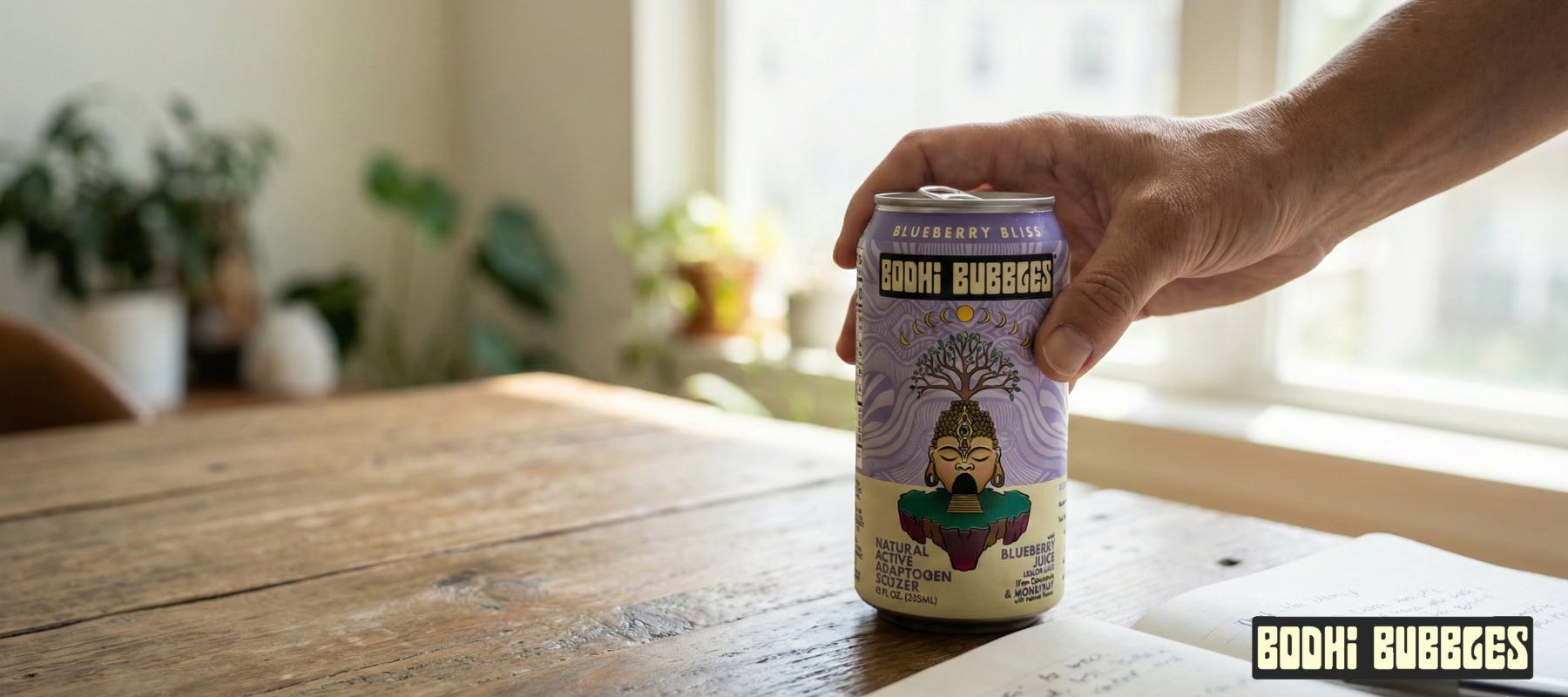
Let’s be honest: No beverage, functional, alcoholic, or otherwise, will magically give you the catch.
But here’s where it gets interesting: Certain botanicals and ingredients, especially when working synergistically, can create the physiological conditions that make the catch possible.
This isn’t about one miracle ingredient. It’s about a carefully designed blend where each botanical addresses a different layer of nervous system regulation, from the neurochemical to the physiological to the cognitive.
The Alcohol Trap
When you’re stressed, anxious, or activated, alcohol offers an immediate solution: exit the body. Numb out. Check out. Don’t feel.
It works in the short term. That’s why we use it. But it has three major problems:
-
It’s dissociative. You’re not regulating your nervous system; you’re abandoning it.
-
It prevents processing. The emotions you numb don’t disappear. They go underground.
-
It shrinks your window. Regular alcohol use actually decreases your capacity to tolerate discomfort, making you more reactive over time.
The next day, your nervous system is even more dysregulated (hangxiety, anyone?), and you’ve learned nothing about how to actually be with difficult sensations.
The Adaptogen Alternative
This is where botanicals like those in Bodhi Bubbles offer something fundamentally different.
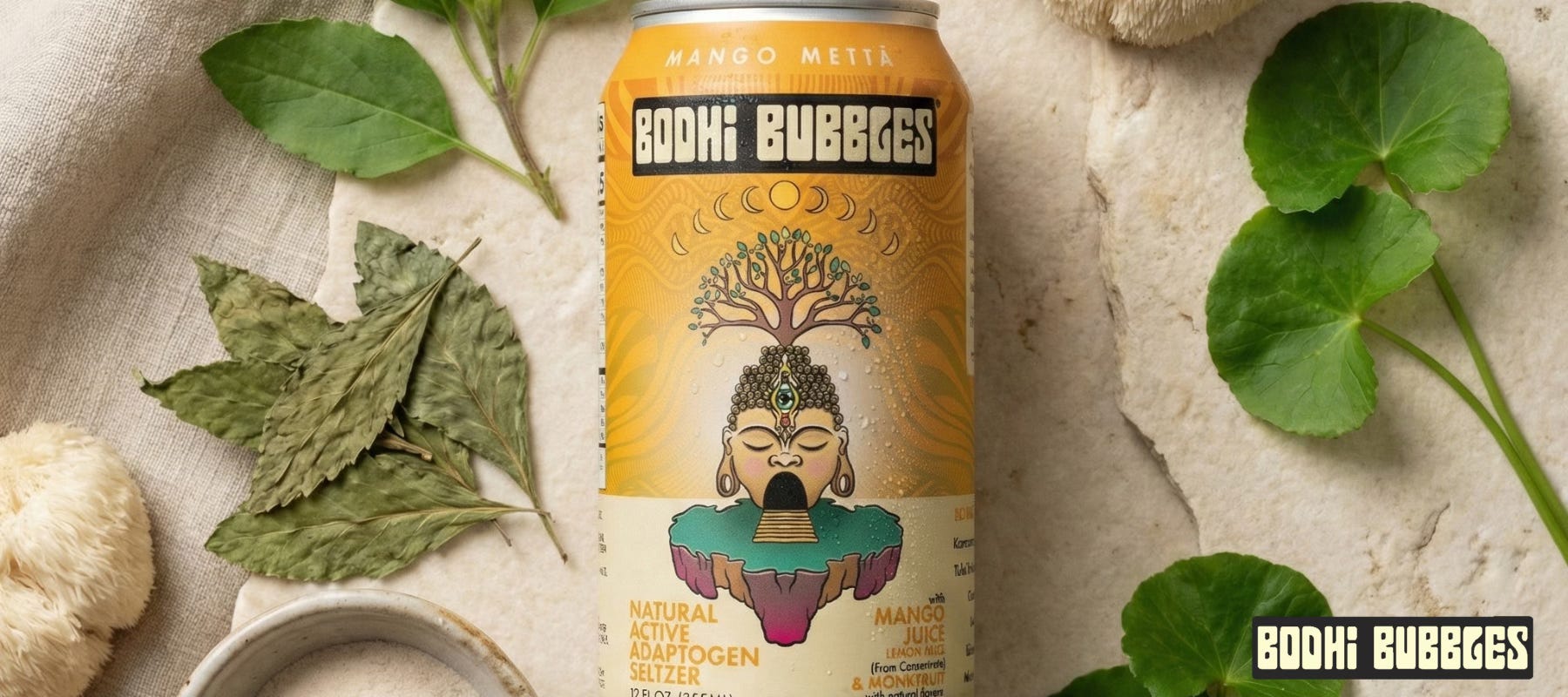
They don’t numb you out. They tune you in.
Think of them as nervous system allies, each one supporting a different aspect of your capacity to pause, feel, and choose.
-
Kanna, Zembrin® (Sceletium tortuosum):
Traditional use by Khoisan hunters required acute presence and nervous system regulation, not dissociation. Modern research shows Zembrin modulates serotonin and PDE4, reducing amygdala reactivity while maintaining cognitive clarity. Translation: It lowers the volume on the alarm bells without disconnecting you from your body.
In the context of the catch, Zembrin creates a wider window. That 1-2 second gap? It might stretch to 3-4 seconds. Enough to actually feel what’s happening instead of being immediately hijacked.
-
Tulsi (Holy Basil):
Revered in Ayurveda as the “Queen of Herbs,” tulsi is a potent adaptogen that helps modulate cortisol, your primary stress hormone. When cortisol is chronically elevated (hello, modern life), your baseline activation stays high. Everything feels like a crisis. Tulsi helps recalibrate your stress response system, creating more space between “normal day stuff” and “five-alarm fire.”
From a catch perspective, tulsi helps your body distinguish between actual threats and perceived ones. It’s like turning down the sensitivity on your alarm system so you’re not constantly triggered.
-
Damiana:
This Central American botanical has been used for centuries to support nervous system balance and lift mood without sedation. Damiana contains compounds that support GABA and dopamine pathways, neurotransmitters essential for feeling both calm and engaged (not just one or the other).
The catch requires you to be present enough to feel, but regulated enough not to panic. Damiana helps create that sweet spot—grounded but not checked out.
-
Gotu Kola:
Known in Ayurveda as “the herb of enlightenment,” gotu kola has a unique dual action: it’s both calming and cognitively enhancing. Research shows it reduces anxiety while improving focus and memory. It’s also one of the few herbs shown to support BDNF (brain-derived neurotrophic factor), essentially helping your brain build new pathways.
Why does this matter for the catch? Because nervous system regulation isn’t just about calming down—it’s about building new response patterns. Gotu kola supports the neuroplasticity that allows you to rewire reactive habits into conscious choices.
-
Lion’s Mane:
This medicinal mushroom is a powerhouse for nerve growth factor (NGF) and cognitive clarity. But here’s what often gets missed: better cognitive function means better interoception. When your prefrontal cortex (thinking brain) can actually communicate with your limbic system (feeling brain), you have more capacity to name what you’re experiencing instead of just being swept away by it.
Lion’s mane supports the neural pathways that allow you to think and feel simultaneously. Essential for the catch.
-
Magtein® (Magnesium L-Threonate):
Crosses the blood-brain barrier to support synaptic density and neuroplasticity. But here’s what matters for regulation: Magnesium is the “calming mineral.” It’s involved in muscle relaxation, neurotransmitter function, and HPA axis regulation (your stress response system).
When your body has adequate magnesium, your baseline activation level drops. You’re not as close to the edge. Small triggers don’t feel like big threats. You have more room to feel without overwhelming.
The Critical Difference:
These aren’t about achieving a state. They’re about creating nervous system resilience, helping to build the capacity to feel difficult sensations without immediately needing to escape them.
Each botanical addresses a different layer:
-
Zembrin widens the catch window
-
Tulsi lowers your baseline activation
-
Damiana keeps you present without panic
-
Gotu Kola helps you build new neural pathways
-
Lion’s Mane sharpens the connection between thinking and feeling
-
Magtein creates physiological calm from the inside out
Together, they create the conditions where the catch isn’t just possible, it’s accessible.
You’re not checking out. You’re checking in from a nervous system that finally has the bandwidth to feel without fragmenting.
Training the Catch: A 7-Day Practice
The catch isn’t a one-time thing. It’s a skill. A muscle. You build it through practice.
The Bodhi Bubbles Catch
Try this for one week:
-
Morning: Baseline Check-In (3 minutes)
-
Before caffeine, before screens, sit quietly
-
Body scan: What do you feel? Tension where? Breath how?
-
Rate your activation 1-10 (1 = deeply calm, 10 = fight or flight)
-
Just notice. No judgment.
-
-
Midday: The Trigger Log
-
When you feel activated (anger, anxiety, frustration), pause
-
Ask: Where is this in my body? What sensations am I noticing?
-
Write it down: “Tight chest, shallow breath, heat in face”
-
This builds your personal “activation map”
-
-
Evening: The Bodhi Ritual
-
Open a can of Bodhi Bubbles with intention
-
Before drinking: Notice your state (activation level, sensations)
-
While drinking: Slow down. Taste. Feel the carbonation, the temperature
-
20 minutes later: Check in. What’s different?
-
Track: Did you notice the shift happening? Where did you feel it first?
-
-
Before Sleep: The 90-Second Practice
-
Think of something mildly annoying from your day
-
Notice where you feel it in your body
-
Stay with that sensation for 90 seconds (set a timer)
-
-
Don’t change it, don’t explain it. Just feel it.
-
Notice: It probably shifts, softens, or moves on its own
-
What You’re Training:
-
Interoceptive accuracy: Feeling sensations in real time
-
Window of tolerance: How much activation you can handle before reactivity
-
Recovery speed: How quickly you can return to baseline after activation
-
Somatic awareness: Recognizing your personal patterns
The Window Widens
When you train the catch. You don’t eliminate triggers. You don’t stop feeling. You just get a little more space between stimulus and response.
And in that space? Everything changes.
The Invitation: Feel Your Way Home
We’ve spent decades being told to think our way through stress. To be rational. To override our emotions with logic.
It hasn’t worked. Anxiety rates are higher than ever. We’re more medicated, more numbed out, more disconnected from our own bodies than any generation in history.
What if the solution isn’t less feeling, but more?
What if the way through stress isn’t around it or over it, but directly into it, with a nervous system regulated enough to actually be with what arises?
The catch isn’t about control. It’s about capacity. The capacity to feel without fragmenting. To be activated without being hijacked. To experience emotion without becoming it.
Bodhi Bubbles isn’t magic. It’s a tool. It creates the physiological conditions, calmer baseline, wider window, clearer interoception, where the catch becomes possible.
But the practice is yours.
The catching. The feeling. The 90 seconds of just being with what is. The choice to respond instead of react.
This is nervous system training. This is embodiment. This is what it means to be fully human, not ruled by ancient alarm systems, but informed by them.
Between stimulus and response, there is a space.
It’s not intellectual.
It’s somatic.
And it’s yours to reclaim.
This Week’s Practice
Set 3 phone alarms per day labeled:
“PAUSE: What do I feel in my body right now?”
When it goes off:
-
Stop whatever you’re doing
-
Notice 3 physical sensations (no judgment)
-
Take 3 conscious breaths
-
Return to your day
Track patterns:
-
When are you most activated? (Morning? After certain people? During certain tasks?)
-
What are your signature sensations? (Chest tightness? Jaw clench? Stomach flutter?)
-
How long does it take you to notice you’re triggered? (Real time? 5 minutes later? Next day?)
Replace one reactive habit:
-
Instead of reaching for phone when anxious → 90-second pause
-
Instead of immediately responding to that email → Feel first, respond second
-
Instead of pouring wine after stressful day → Open Bodhi, practice the ritual
Journal:
-
What am I afraid will happen if I actually feel my stress instead of numbing it?
-
What becomes possible when I have 3 seconds of space between trigger and reaction?
These statements have not been evaluated by the Food and Drug Administration. This product is not intended to diagnose, treat, cure, or prevent any disease. Bodhi Bubbles contains a synergistic blend of adaptogens and nootropics including Zembrin®, Magtein®, Tulsi, Damiana, Gotu Kola, and Lion’s Mane, botanicals studied for their ability to support nervous system regulation and embodied presence. Because the catch isn’t about escaping what you feel. It’s about finally having the capacity to be with it.
Ready to train the catch? Shop Bodhi Bubbles →
The space between stimulus and response isn’t empty. It’s full of choice, wisdom, and the possibility of responding as your best self instead of your most reactive one. Welcome to the practice.
